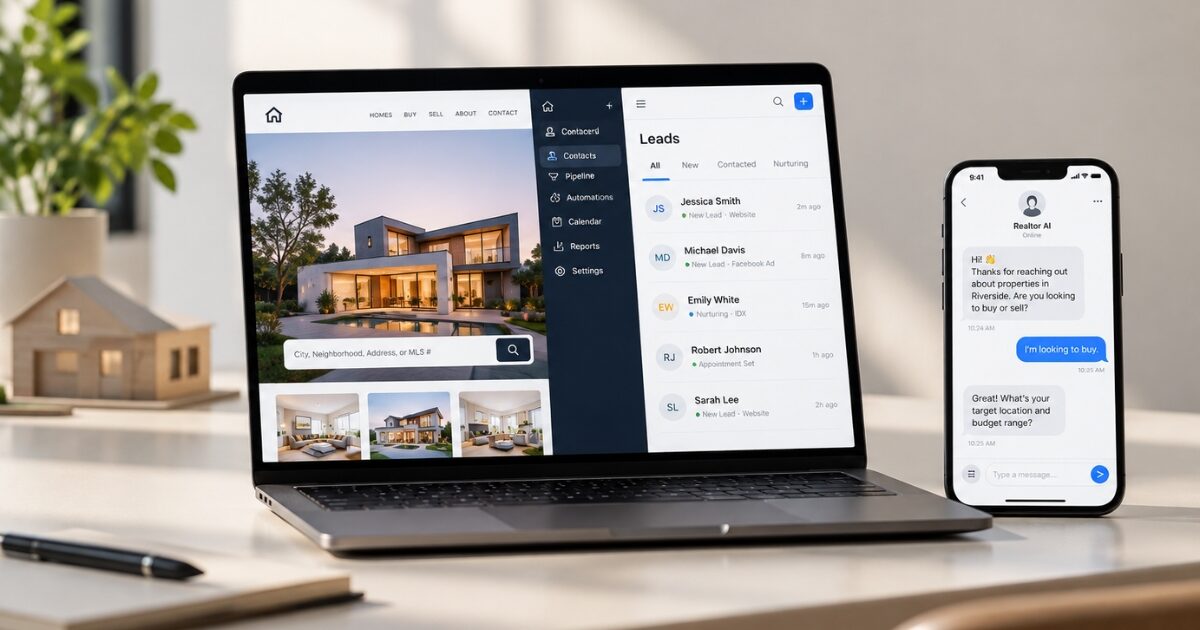
Speed to lead is the whole game, and every agent has lived the moment it is lost: a buyer registers on your website at 9:40 p.m., you see the notification the next morning, and by the time you call they’ve already booked a showing with someone else.
Online leads don’t reward the best agent. They reward the first agent who responds in a helpful way. This article shows how to build a speed-to-lead system with GoHighLevel and AI agents so every lead gets a fast, personal response — even when you’re at a closing.
In this guide
- Why speed to lead matters so much
- Step 1: Get every lead into one place
- Step 2: Build an instant-response workflow
- Step 3: Add an AI agent for conversations you can’t take
- Step 4: Nurture the leads who aren’t ready yet
- Step 5: Connect it back to your website
- A simple starting point

Why speed to lead matters so much
Lead response research has been cited across sales and real estate for years, and the pattern is consistent: the chance of reaching and qualifying a lead drops sharply as minutes turn into hours. Online buyers and sellers usually contact several agents at once, and the conversation tends to go to whoever answers first.
You can’t personally answer every inquiry within minutes, seven days a week. A system can.
Step 1: Get every lead into one place
Leads arrive from everywhere — your website forms, IDX registrations, Zillow, Facebook ads, open house sign-ins. If they land in different inboxes, speed is impossible.
In GoHighLevel, connect each source so it creates a contact automatically:
- Website contact and valuation forms
- IDX search registrations
- Facebook and Google lead forms
- Portal leads forwarded by email or integration
Tag each contact by source and intent (buyer, seller, investor, renter) so your automations can respond appropriately.
Step 2: Build an instant-response workflow
Create a workflow that triggers the moment a new lead is created:
- Instant SMS from your business number, written like a real person: “Hi Sarah, it’s Alex — saw you were looking at homes in Riverside. Anything specific catch your eye?”
- Instant email with something useful: a saved search link, a home valuation, or a neighborhood guide.
- Internal alert to you or your team via push notification or SMS.
- Pipeline stage set to “New Lead” so nothing hides in a list.
Always follow the rules for text messaging in your area. In the US that includes getting proper consent and registering your business texting number for A2P 10DLC.
Step 3: Add an AI agent for conversations you can’t take
This is where AI changes the game. Instead of a text that says “I’ll get back to you,” an AI agent can hold a real conversation:
- AI chat on your website and in SMS threads that answers common questions, asks qualifying questions and suggests a time to talk.
- AI voice agents that answer or return calls, collect basic details — timeline, budget, area, pre-approval status — and book an appointment on your calendar.
The goal isn’t to replace you. It’s to make sure every lead gets a helpful first conversation, so the lead you call back is warm, qualified and expecting you.
Let AI handle the first five minutes. You handle the relationship.
Guardrails that keep AI helpful
- Give it a clear script: who you are, which areas you serve, what it can and can’t answer.
- Tell it never to give legal, lending or pricing guarantees.
- Hand off to a human the moment a lead asks for one or shows high intent.
- Review conversations weekly and refine the prompts.
Step 4: Nurture the leads who aren’t ready yet
Most online leads aren’t buying this month. A long-term nurture sequence keeps you top of mind without manual effort:
| Timeframe | Touchpoint |
|---|---|
| Day 1–3 | Personal texts and a helpful email with listings |
| Week 1–4 | Market updates and neighborhood guides |
| Month 2–6 | Monthly market snapshot, new listing alerts |
| Ongoing | Home anniversary or valuation check-ins for past clients |
When a lead replies, clicks a listing or books a call, the workflow should stop the automated messages and alert you.
Step 5: Connect it back to your website
Your website should feed this system, not sit beside it. That means:
- Forms that create GoHighLevel contacts with the right tags.
- IDX registrations that sync with search behavior.
- A booking calendar embedded on key pages.
- Chat on high-intent pages like listings, valuations and contact.
A simple starting point
You don’t need everything on day one. Start with this:
- Route every lead source into GoHighLevel.
- Send an instant, personal SMS and email.
- Alert yourself and create a pipeline card.
- Add an AI chat or voice agent once the basics are working.
Speed to lead isn’t about working more hours. It’s about building a website and CRM that respond for you — so you can spend your time with the clients who are ready to move.
What the speed to lead window actually is
Speed to lead is simply the time between an enquiry arriving and a human responding. The reason it matters so much in property is structural: buyers enquire on several listings at once, and the first agent to reply usually becomes the agent they deal with.
| Reply time | What the sender has usually done |
|---|---|
| Under 5 minutes | Still on the site, still looking |
| Within an hour | Moved on, but the enquiry is fresh |
| Same day | Probably spoken to someone else |
| Next day | Has an agent, or has cooled off |
| Two days or more | The message reads as an intrusion |
Nothing in that table requires software. Good speed to lead is a decision about how you structure your day, and the tooling only exists to make the decision easier to keep.
Why speed to lead beats almost every other improvement
Because it costs nothing and compounds with everything else. Compare it with the alternatives a solo agent is usually offered.
- Against more traffic: doubling visitors while replying the next day mostly doubles the number of people who choose someone else.
- Against a redesign: a better-looking site does not answer the phone. Speed to lead is what converts the visitors you already have.
- Against buying more leads: paying for volume you cannot answer promptly is the most expensive mistake in this list.
- Against a bigger CRM: software records what happened. It does not shorten the gap on its own.
Which is why speed to lead is the first thing to fix and almost never the first thing anyone sells you. There is no product to buy, so nobody markets it.
The realistic version for a working agent
Five-minute replies are impossible when you are in a showing, and pretending otherwise is why most speed to lead advice gets abandoned. This is the version that survives a normal week.
- Automate the acknowledgement, and make it honest. “I’m with clients until 4pm and will reply properly then” protects your speed to lead position without lying about availability.
- Give a specific time and meet it. A stated hour that passes is worse than no acknowledgement.
- Check enquiries at two fixed points a day and clear all of them. Consistency beats sporadic instant replies.
- Answer the question they asked first, before introducing yourself or asking for anything.
- Keep the first reply under sixty words. Long messages read as automated even when they are not.
That is achievable alongside a full workload, and it puts your speed to lead ahead of most competitors in any market, because the bar is genuinely low.
Where AI genuinely helps, and where it does not
An AI agent can hold the first minute convincingly and should not try to hold the conversation. Used within that limit it improves speed to lead considerably; used beyond it, it costs you trust.
| Task | Suitable for AI? |
|---|---|
| Instant acknowledgement | Yes |
| Answering factual questions about a listing | Yes, from the feed |
| Offering appointment slots | Yes |
| Qualifying budget and timing | Carefully, and briefly |
| Advising on price or negotiation | No |
| Anything a licence covers | No |
Three rules if you use one: make clear it is an assistant, hand over to you quickly, and never let it give advice that requires a licence. Speed to lead gained by misleading someone about who they are talking to is not a gain.
Automated outreach is also regulated — calls and texts fall under rules administered by the Federal Communications Commission — and AI disclosure requirements are tightening in several states. Check what your brokerage requires before switching anything on.
How to measure your own speed to lead
Most agents believe they reply faster than they do. One month of honest record-keeping settles it, and it needs nothing more than a spreadsheet.
- Log the time each enquiry arrived and the time you personally replied.
- Take the median, not the average. One weekend outlier ruins an average and tells you nothing.
- Count the ones you never answered at all. This number is usually the shock, and closing it is free.
- Note which got a reply back. Correlate that with your speed to lead and the case makes itself.
Review it once a quarter. Speed to lead is a habit rather than a project, and the measurement is what keeps the habit honest once the initial enthusiasm fades.
The five places enquiries get lost
Before improving how fast you reply, make sure you are receiving everything. Poor speed to lead is often not slowness at all but messages that never reached anyone.
- The contact form silently fails. Depressingly common and invisible. Submit a test from your own site to two different addresses, today.
- Notifications go to an address you never open. An old brokerage address, or a forwarding rule that broke.
- Enquiries land in spam. Your own site’s mail frequently ends up there if it sends from the wrong domain.
- IDX enquiries go to the vendor, not to you, and sit in a dashboard nobody checks.
- Portal messages sit in a portal inbox with notifications switched off.
Any one of those turns perfect speed to lead into zero without producing a single visible symptom. Check all five once a quarter; it takes ten minutes.
What the first reply should contain
Fast and useless is only marginally better than slow. Good speed to lead means the first message does work, not just arrives quickly.
| Include | Why |
|---|---|
| A direct answer to what they asked | Proves a person read it |
| One fact they could not have found | Demonstrates local knowledge instantly |
| One question | Gives them something easy to reply to |
| What you will do next | Sets the relationship going |
| Nothing else | Under sixty words reads as human |
Leave out the biography, the market report and the request for their budget. Those belong in the second or third exchange, once speed to lead has done its job and a conversation actually exists.
Setting it up this week
Four steps, none of which costs anything, and together they fix speed to lead for most solo agents permanently.
- Test every route an enquiry can take — site form, listing enquiry, portal, phone. Confirm each reaches you.
- Turn on push notifications for whichever inbox they land in.
- Write one honest automatic acknowledgement with a specific reply time in it.
- Book two daily slots in your calendar to clear enquiries, and treat them as appointments.
An hour of setup, then a habit. That is the whole of speed to lead, and it will outperform anything else you could buy with the same hour.
What happens after the first reply
Speed to lead wins you the conversation. It does not win you the client, and treating the fast reply as the finish line is how agents end up with a long list of people who answered once and were never heard from again.
Most property enquiries are months away from a transaction. Someone browsing listings in March may well buy in January, and the agent they call is the one who stayed quietly present in between without pestering them.
- Three messages, then stop. If someone has not replied after three, move them to alerts. Continuing damages your reputation and rarely converts.
- Saved-search alerts are the long game. They arrive monthly, cost nothing, and keep your name attached to something useful.
- Make each message worth opening. A listing that matches, a genuine local update. Not “just checking in”.
- Keep the record. What they were looking for and when, so the next conversation starts where the last one ended.
Handled that way, speed to lead and patient follow-up work as one system rather than two. The fast reply earns the right to stay in touch; the staying in touch is what eventually produces the commission.
Common objections, answered
Three reasonable reservations come up whenever speed to lead is raised with working agents. None of them is silly, and none survives close inspection.
“Replying instantly makes me look desperate.” It does the opposite. Buyers read a fast, useful reply as competence and availability, which is exactly what they are shopping for. Desperation comes from the content of the message, not its timing — three chasing messages in a day will read badly at any speed.
“Most of these enquiries are not serious.” Many are not, and you cannot tell which from the enquiry itself. The cost of a sixty-word reply to someone who never responds is almost nothing; the cost of ignoring the one who was serious is a commission. The arithmetic favours answering everything, which is the whole argument for speed to lead.
“I cannot be on my phone all day.” Nor should you be. This is what the honest automatic acknowledgement is for. Good speed to lead is not constant availability; it is never leaving someone wondering whether their message arrived.
Frequently asked questions
Does speed to lead matter for referrals too?
Less, because they are not comparing you with three other agents. It still matters for the impression it creates, and a referral who waits two days for a reply arrives at the first meeting with reservations.
Is an automated first reply dishonest?
Not if it is accurate. An acknowledgement saying when a person will respond is a courtesy. One written to imply you are personally typing at 11pm is not, and people can usually tell.
What if I only get a few enquiries a month?
Then speed to lead matters more, not less. With three enquiries a month, losing one to a slow reply is a third of your pipeline, and you need no software at all to fix it.
Do I need a CRM to improve speed to lead?
No. Below roughly fifteen enquiries a month, notifications that reach your phone and a twice-daily habit of clearing them work perfectly well. Buy a CRM when the volume genuinely exceeds what you can hold in your head.
The bottom line
Speed to lead is the cheapest improvement available to a small agent and the one most consistently ignored. It requires no new software, no budget and no redesign — only a decision that every enquiry gets an honest acknowledgement immediately and a human reply the same day.
Measure yours for a month before changing anything. Most agents find the problem is not the enquiries they answered slowly, but the ones they never answered at all.

Asraful Islam
Real estate website developer and founder of Reaplex. 200+ real estate websites built, rated 5.0 from 180+ reviews on Fiverr and Upwork.
More about me