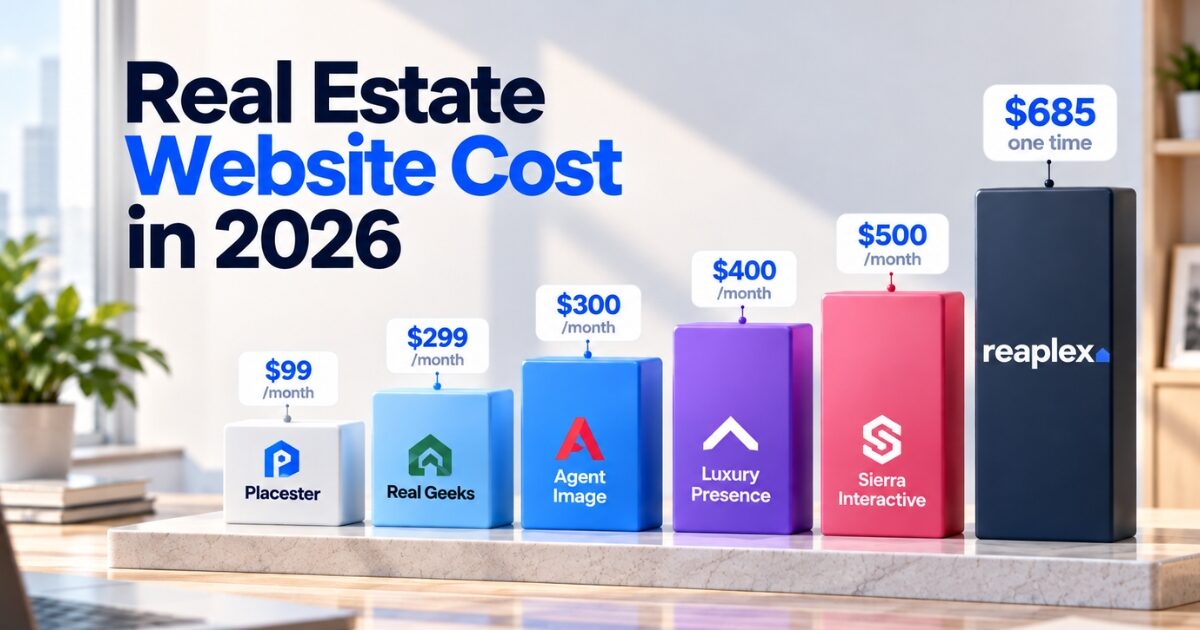
The real estate website cost in 2026 takes one of two shapes: either $99 to $500 a month forever on a subscription platform, or $685 to $15,000 once for a site you own outright. The monthly route is cheaper to start and more expensive by year two. Which is right depends less on the price than on what you earn.
That last part is the bit almost nobody writes about, so this guide puts the published prices next to what agents actually make. The numbers are uncomfortable.
In this guide
- What is the average real estate website cost in 2026?
- What do real estate agents actually earn?
- What does each price tier actually buy?
- Which costs appear only after you sign?
- What does five years actually cost?
- When is a monthly platform the right choice?
- How should an agent decide?
What is the average real estate website cost in 2026?
Real estate website cost falls into three honest bands. Subscription platforms run roughly $99 to $500 a month. Custom agency builds run $3,000 to $15,000 up front. Independent developers sit in between, typically $700 to $3,000 one time. Here is the published pricing as of 2026.
| Option | Up front | Ongoing | Year one |
|---|---|---|---|
| Placester | — | from $99/mo | ~$1,188 |
| Real Geeks | $250 | ~$299/mo | ~$3,838 |
| Luxury Presence | $1,500–3,000 | $400–500/mo | $6,300–9,000 |
| Sierra Interactive | — | $500–1,500/mo | $6,000–18,000 |
| Agent Image | $200–4,000 | $100–300/mo | $1,400–7,600 |
| Custom agency build | $3,000–15,000 | hosting only | $3,100–15,300 |
| Independent developer | $685–3,000 | hosting only | $785–3,300 |
Figures come from each platform’s published pricing and from independent cost breakdowns including Luxury Presence and Dwellstack’s breakdown for solo agents. Treat every monthly figure as a floor — most rise once IDX and add-ons are attached.
Real estate website cost against what agents actually earn
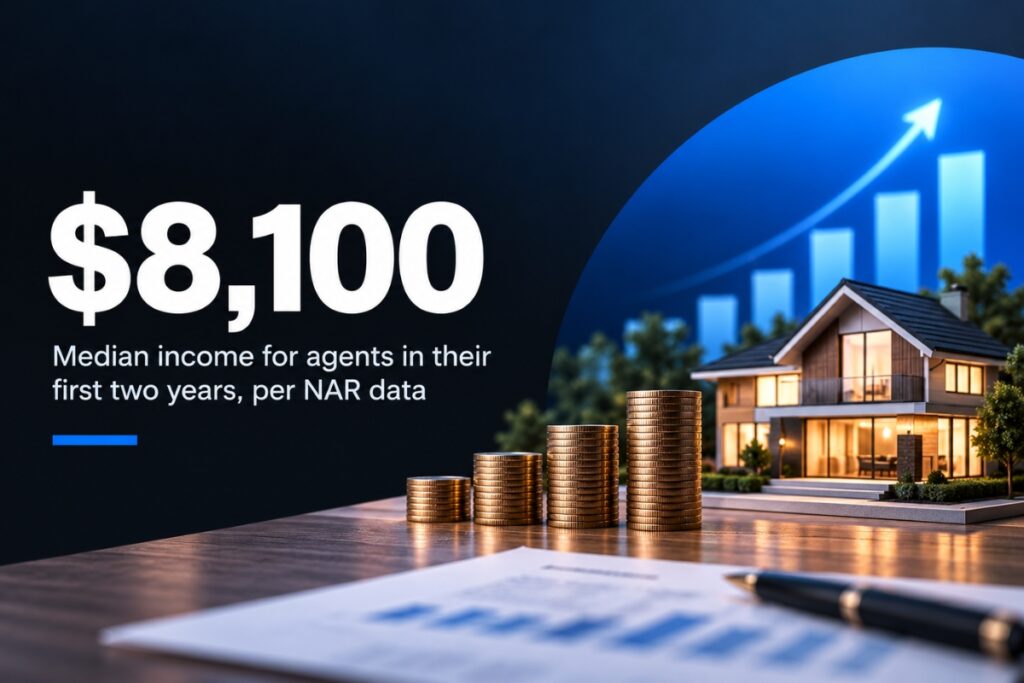
This is the number that should decide your budget. According to National Association of Realtors data, agents with two years or less in the business earn a median of $8,100 a year. It climbs to roughly $30,000 by years three to five, and around $70,000 by years six to fifteen.
Set the real estate website cost bands against that and the picture changes completely.
| Website choice | Year-one cost | Share of a new agent’s $8,100 | Share at $30,000 |
|---|---|---|---|
| Placester, entry tier | ~$1,188 | 14.7% | 4.0% |
| Real Geeks | ~$3,838 | 47.4% | 12.8% |
| Luxury Presence, low end | ~$6,300 | 77.8% | 21.0% |
| Sierra Interactive, low end | ~$6,000 | 74.1% | 20.0% |
| Owned site at $685 | ~$785 | 9.7% | 2.6% |
A $500-a-month platform consumes three quarters of what a first-or-second-year agent earns in a year. That is not a marketing argument, it is division. And it matters more than it looks, because 75% of new agents leave the industry within their first year and 87% are gone within five, according to industry data compiled from NAR figures. The agents most likely to sign a long contract are the ones least able to carry it.
The market is shrinking, too. NAR membership sat at about 1.45 million in early 2026, down from a peak near 1.6 million, and NAR leadership has projected roughly 1.2 million by the end of 2026. Fixed monthly costs are hardest to carry in exactly that kind of market.
What does each real estate website cost tier actually buy?
The bands buy noticeably different things, and the differences are not always the ones being advertised.
Under $100 a month
A template, your photo and an IDX feed. It gets you online this week. The trade-off is that these sites look like every other site on the same platform, and search visibility is usually thin because the template gives you little control over page structure or speed. Fine as a business card. Weak as a lead source.
$100 to $500 a month
Better design, a real CRM and support. You are renting a system rather than buying a website — which is genuinely worth it if you use the CRM and the lead routing every day. If you only use it as a website, you are paying a software price for a brochure.
One-time builds, $685 to $15,000
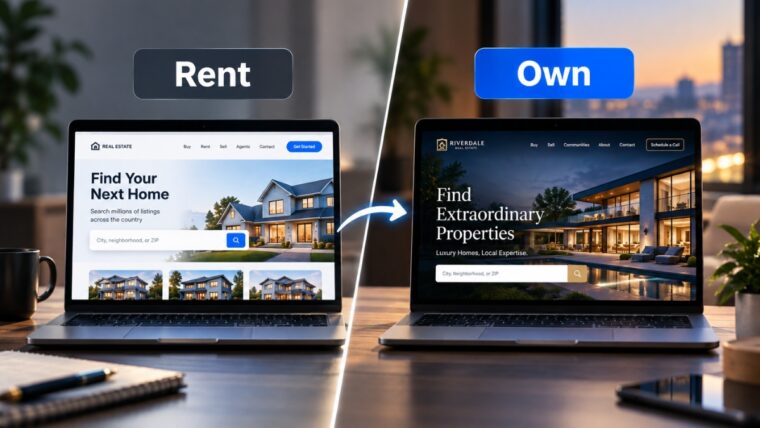
You own the design, the content and the domain. Ongoing cost drops to hosting, usually $100 to $300 a year, plus whatever your IDX provider charges. The range is wide because a ten-page agent site and a twenty-agent brokerage build are not the same job. What matters is whether the result is yours: if you stop paying, does the site stay up? That single question separates renting from owning.
Which parts of the real estate website cost appear only after you sign?
The quoted real estate website cost is rarely the whole price. Four costs show up later, and they are the ones that turn a $99 plan into a $250 month.
- IDX itself. Plugins and feeds typically run $30 to $200 a month, and a custom IDX or RETS integration can add $2,000 to $8,000 up front.
- MLS fees. Your MLS usually charges its own data-access fee, often $30 to $100 a month, per board. Agents covering two boards pay twice.
- Content. Nearly every platform hands you an empty site. Neighbourhood pages, bios and guides are either your evenings or someone’s invoice.
- The cost of leaving. On most subscription platforms the site, and sometimes the content, does not come with you. Budget for rebuilding when you go.
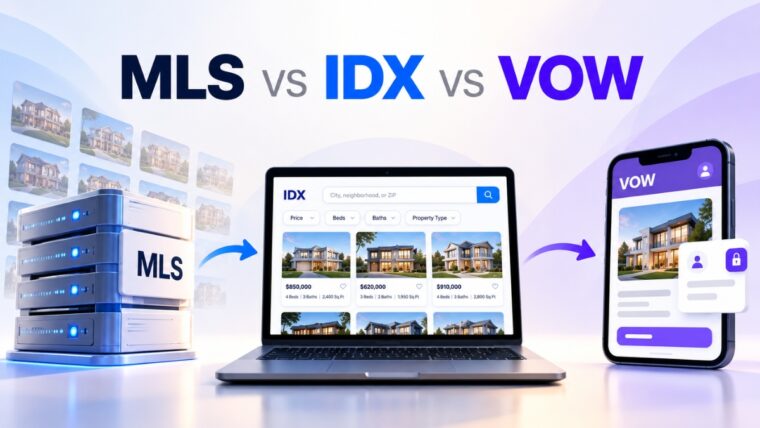
IDX pricing in particular is quoted on a call rather than published, which makes it hard to compare. If you want the mechanics first, start with the plain-English guide to IDX, MLS and VOW.
What does five years of real estate website cost come to?
One year flatters subscriptions. Five years of real estate website cost is the honest comparison, because that is roughly how long a working agent keeps a website. Hosting is counted at $150 a year for owned sites; IDX is excluded from both sides, since you pay it either way.
| Option | Year 1 | Year 3 | Year 5 |
|---|---|---|---|
| Placester at $99/mo | $1,188 | $3,564 | $5,940 |
| Real Geeks at $299/mo | $3,838 | $11,014 | $18,190 |
| Luxury Presence at $450/mo + $2,000 setup | $7,400 | $18,200 | $29,000 |
| Owned site at $685 + hosting | $835 | $1,135 | $1,435 |
| Custom build at $5,000 + hosting | $5,150 | $5,450 | $5,750 |
By year five, a mid-tier subscription has cost more than a $15,000 custom build. That is the whole argument for ownership in one row — and it is also why the honest answer is not always “buy”.
When is a monthly platform the right choice?
Often enough that anyone who tells you otherwise is selling something. A subscription is the better call in four situations.
- You need to be live this week. A template configured today beats a custom build that launches in six weeks.
- You will genuinely use the CRM. If the platform is your pipeline, your dialler and your follow-up, you are buying software, not a website, and the price is fair.
- You are testing whether real estate is for you. With a 75% first-year exit rate, not committing capital is a reasonable decision.
- Your brokerage pays for it. Free is hard to beat, even when the site is generic.
Owning makes more sense once the website is a real part of how you win clients, once you have survived the first two years, and once you intend to publish content that should accumulate value for you rather than for a platform you rent.
How should an agent decide on a real estate website cost?
Four questions, in order. They take about ten minutes and they settle the real estate website cost question for good.
- What did you earn last year? Keep total website cost under about 10% of it. At $8,100 that is roughly $800 a year, which rules out most monthly plans and rules in a modest owned site.
- Will you use the CRM every day? If yes, price the platform as software. If no, you are overpaying for a brochure.
- Do you plan to publish? If you will write neighbourhood pages and guides, own the site. Content is an asset only if you keep it.
- What happens if you stop paying? Ask the vendor directly, in writing. The answer tells you whether you are buying or renting.
What is the right real estate website cost for your situation?
There is no single answer, because the right real estate website cost is a share of what you earn, not a fixed figure. The table below converts the usual price bands into the thing that actually matters: how much of one commission the site consumes each year.
| Where you are | Sensible annual spend | What that buys |
|---|---|---|
| Licensed, no closings yet | $0–$300 | Domain, one-page site, Google Business Profile |
| Part-time, 1–3 deals a year | $300–$800 | A real site you own, no IDX yet |
| Solo full-time, 6–12 deals | $800–$1,800 | Owned site plus IDX and hosting |
| Small team | $1,800–$4,000 | Multi-agent site, CRM integration |
| Luxury or high-volume | $4,000+ | Custom design, ongoing service |
Read down that table and one thing stands out: the real estate website cost that wrecks a new agent is trivial to a team doing forty deals. The product is not the problem. The mismatch between the price and the income is. What the lower bands actually buy is broken down in what $500 to $1,000 gets you.
What pushes the real estate website cost up?
Five things account for nearly all the variation between a $685 quote and a $9,000 one. Knowing which of them you are actually buying is how you avoid paying for the ones you do not need.
- Custom design versus a configured template. The single largest driver. Bespoke design work is skilled labour and it is priced accordingly.
- Number of MLS boards. Each additional board usually adds a monthly IDX charge, so a two-board agent carries a permanently higher real estate website cost than a one-board agent on identical software.
- Page count. Five pages and twenty-five pages are different jobs. Neighbourhood pages in particular add up.
- Integrations. CRM, e-signature, calendar booking, review widgets. Each one is configuration time.
- Ongoing service. Whether someone else makes your changes is often half the monthly fee.
Notice that only two of the five have anything to do with how well the site performs in search. Speed, indexable listing pages and useful local content are what earn traffic, and none of them is expensive.
What can you safely cut from the real estate website cost?
Quite a lot, in year one. These are the line items that most often appear on a quote and least often produce a client for a solo agent.
- IDX, in your first year. Buyers search Zillow. Your listing pages will not outrank the portals from a standing start, and skipping IDX removes $360–$1,200 a year from the real estate website cost.
- A custom logo package. A clean wordmark is enough until you have income to protect.
- Home valuation tools. Useful later, a distraction before you have traffic to convert.
- Paid chat widgets. A phone number you actually answer beats a chatbot nobody staffs.
- Premium stock photography. Photographs of your actual market are better and free.
What you should not cut: your own domain, fast hosting, and enough pages to say who you are and where you work. Those three are the whole foundation and together they are the smallest part of any real estate website cost.
How does the real estate website cost compare with other marketing?
A website is rarely the most expensive thing an agent buys, which is worth remembering when a $685 quote feels steep. Here is the same money spent elsewhere.
| Spend | Typical annual cost | What you own afterwards |
|---|---|---|
| Owned website, one-time build | $685 once, then hosting | The site, the domain, the content |
| Monthly platform | $1,200–$3,600 | Domain and content only |
| Portal lead packages | $3,000–$12,000 | Nothing — leads stop with payment |
| Direct mail, 1,000 homes monthly | $6,000–$9,000 | Nothing |
| Professional listing photography | $150–$400 per listing | The images |
Against portal lead fees, the real estate website cost looks modest, and it is the only line in that table that accumulates. Every page you publish stays published; every month of portal leads disappears the moment the card declines.
A twelve-month real estate website cost plan at three budgets
Sequencing matters more than the total. Spend in this order and each purchase makes the next one worth more.
- On $200 a year. Domain and cheap hosting, a one-page site with your photo, your areas and a phone number. Google Business Profile claimed and filled in. This is the floor, and it is enough to be findable.
- On $900 a year. A proper owned multi-page site, three neighbourhood pages written by you, hosting, and a real contact form. Still no IDX. Most of the real estate website cost here is one-time, so year two drops sharply.
- On $1,800 a year. All of the above plus IDX for one board, and a CRM you will actually open. Add IDX only once you are getting enough traffic for listing pages to be worth having.
The pattern to notice: at every budget the writing is free and the software is not. Agents who publish consistently beat agents who bought a more expensive real estate website cost bracket and then left it alone.
How to read a real estate website cost quote without getting caught out
Quotes in this market are deliberately hard to compare. Force every one onto the same five lines and the differences stop hiding.
- One-time build or setup fee, including migration and onboarding.
- Recurring platform fee, multiplied by twelve. Monthly figures are designed to feel small.
- IDX and MLS fees, stated per board.
- Hosting and domain, if not included.
- The cost of a change, once the site is live.
Then total three years rather than one. A real estate website cost of $129 a month is $4,644 over three years; a $685 build with $25 a month of hosting is $1,585. Neither number is shocking alone, and side by side they make the decision for you. Whether either is worth paying is a separate calculation, covered in how to tell if your website pays for itself.
Frequently asked questions
Is a $685 real estate website any good?
It can be, at a defined scope: roughly ten pages, IDX search, lead capture and a mobile-first build you own. What it does not include is ongoing strategy, custom map search or a twenty-agent roster. Price is only meaningful next to scope, so compare the page count and the IDX setup, not the headline number.
Why is IDX priced separately from the website?
Because the listing data is licensed from your MLS, not from your web developer. The MLS charges for access, the IDX vendor charges to receive and display the feed, and both fees continue whoever builds the site. Any quote that bundles IDX invisibly is still paying those fees somewhere.
Do I need a website if I already have a brokerage profile page?
You need something you control. A brokerage profile disappears the day you change brokerages, and it cannot rank for the neighbourhood searches that bring in buyers. A single owned page with your name, your market and a clear contact path outperforms a roster entry, and it moves with you.
How long does a real estate website take to build?
Template platforms are live the same week. A custom build usually runs two to six weeks, and the slow part is rarely the design — it is MLS approval for your IDX feed, which takes anywhere from a few days to two weeks depending on the board, plus the time it takes to write real content.
Why do quotes for the same site vary so much?
Because “the same site” rarely is. Custom design, page count, number of MLS boards and whether someone else makes your changes each move the real estate website cost by hundreds. Ask what is included line by line and the spread usually explains itself.
Is a more expensive website more likely to get me clients?
Not on its own. Enquiries come from being findable and fast, and from content about specific places. A higher real estate website cost buys design and service, both real, neither of which Google can see.
What is the cheapest a real website can honestly be?
Around $150–$250 a year if you build it yourself on cheap hosting, and roughly $685 once plus hosting if someone builds it for you. Below that you are usually renting a subdomain you do not control.
Should I pay monthly or once?
Pay monthly if you want a support desk and self-serve editing and will use both. Pay once if you want the lowest three-year real estate website cost and are comfortable asking someone when changes are needed. Both are defensible; the mistake is paying monthly and never logging in.
Does the price include keeping the site updated?
On a platform, yes — updates and security are the provider’s job. On a one-time build, ask explicitly. Managed hosting covers most of it for $8–$30 a month, but it should be a stated line rather than an assumption.
The bottom line
Real estate website cost is not high or low in the abstract. It is expensive or cheap relative to what you earn and how long you keep it. At a median first-two-years income of $8,100, a $500-a-month platform is not a marketing decision, it is most of a year’s profit. At $70,000 and a full pipeline, it is a rounding error.
Work out your number first. Then buy the cheapest thing that genuinely does the job — and make sure you know, in writing, what happens to it the day you stop paying.

Asraful Islam
Real estate website developer and founder of Reaplex. 200+ real estate websites built, rated 5.0 from 180+ reviews on Fiverr and Upwork.
More about me