Do real estate agents need a website in 2026? Yes — but almost certainly not for the reason you have been sold. Most clients do not find their agent by searching. They arrive already referred, and then they look you up. A website’s real job is to survive that check, not to generate strangers.
That distinction decides how much you should spend, what the site needs to contain, and whether you need one at all this year. Here is the evidence.
In this guide
- Where do real estate clients actually come from?
- If referrals dominate, do real estate agents need a website at all?
- What does a site that passes the check need?
- When do you not need a website?
- Is a brokerage profile page enough?
- When does a website start generating clients?

Before asking do real estate agents need a website, where do clients come from?
Not from Google, mostly. In the National Association of Realtors’ 2025 Profile of Home Buyers and Sellers, 43% of buyers used an agent referred to them by a friend, neighbour or relative, and 18% used an agent they had worked with before. That is 61% of business arriving through relationships.
| How buyers found their agent | Share | What your website does there |
|---|---|---|
| Referred by friend, neighbour, relative | 43% | Confirms you are real and competent |
| Used the agent before | 18% | Little — they already trust you |
| Everything else, including online search | Remainder | Discovery, and this is where SEO earns its keep |
This is why the honest answer to “will a website bring me clients?” is: eventually, some. In your first year, the lead sources that actually convert are the unglamorous ones. Sphere of influence, open houses, expired listings and door-knocking convert far more reliably than portal leads, and they are available to a brand-new agent on day one. A website does not replace any of that.
If referrals dominate, do real estate agents need a website at all?
This is the real reason do real estate agents need a website has a yes attached to it: the site is the verification step. Someone gets your name at a barbecue, types it into their phone in the car park, and decides in about fifteen seconds whether you look like a professional. That is the entire transaction your website is responsible for, and it happens after the referral, not before it.
Framed that way, do real estate agents need a website becomes a much smaller and clearer question. You need to look established, be easy to contact, and prove you work in their market. You do not need a fifty-page content operation in month one.
If real estate agents do need a website, what must it contain?
Five things. Everything else is optional until you have transactions paying for it.
- A domain you own. Your name, registered in your own account. This is the one thing that must never sit inside someone else’s platform.
- A real photo and a real bio. Where you work, what you handle, how long you have done it. Specific beats polished.
- An obvious way to contact you. Phone and a form, visible without scrolling, working on a phone.
- Evidence. Reviews, recent sales, neighbourhoods you know. Three real testimonials outperform any amount of design.
- Speed on a phone. Most of these checks happen on mobile data in a car park. A site that takes six seconds has already failed.
Notice what is missing from the list: IDX search. Agents asking do real estate agents need a website almost always overestimate how early they need it. It is genuinely useful once you are chasing organic traffic, but it is not what makes a referral call you. If budget is tight, add IDX when you understand what it costs and what it does, not on day one because a salesperson said so.
When do real estate agents not need a website?
There are real cases where the answer to do real estate agents need a website is no, and anyone who claims otherwise is selling websites.
- You are eight weeks into the business and deciding whether to stay. With roughly three quarters of new agents leaving within a year, spending on infrastructure before you have closed anything is not caution, it is cost.
- Your brokerage gives you a decent profile page and you are pure referral. It is generic and it disappears if you move, but it holds the fort.
- You would build it and never update it. A site with a 2023 bio and a dead phone number actively damages the verification step. No site is better than a stale one.
What none of those cases justifies is signing a long contract for a platform you cannot afford. If you are unsure, the cheapest defensible move is to register your domain, put up one honest page, and leave it at that until the business tells you to do more.
Do real estate agents need a website if they have a brokerage page?
For a while, yes. Permanently, no — which is why do real estate agents need a website of their own comes up again the moment anyone changes brokerage — for two reasons that have nothing to do with design.
First, it is not yours. Change brokerage and the page, the URL and any search visibility it built go with them. Second, a roster entry cannot rank for the searches that matter locally, because it is one of forty near-identical pages on a domain optimised for the brokerage, not for you. It passes the fifteen-second check. It will never do more than that.
When do real estate agents need a website to start generating clients?
When you publish things worth finding. That is the point at which do real estate agents need a website stops being theoretical and starts paying. A site that exists is a business card; a site with genuinely useful local pages is a lead source. The shift happens when you start answering the questions buyers and sellers in your market actually type — what a neighbourhood costs, what the schools are like, what the process looks like.
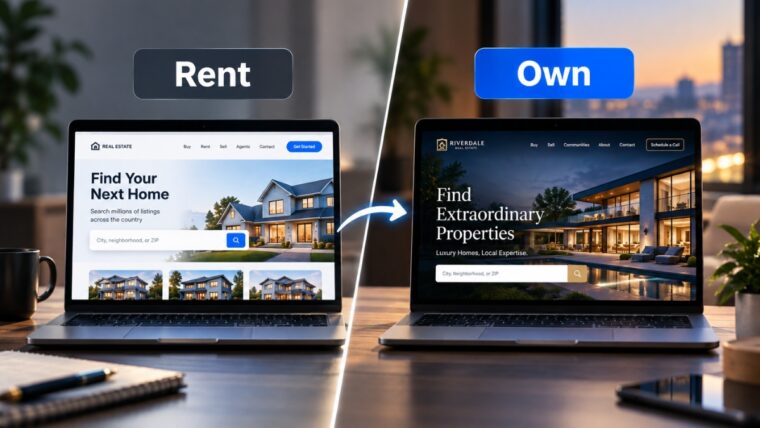
That takes months, not weeks, and it only pays off if the site is yours. Content you publish on a rented platform builds value you hand back the day you cancel, which is the real argument for owning rather than renting.
Do real estate agents need a website to win listings?
Not to win them, but often to be shortlisted for them. Sellers interview two or three agents, and almost all of them look you up first. The website is rarely what closes the appointment; it is frequently what gets you the appointment.
Think of it as the part of the listing presentation that happens before you arrive. A seller comparing three agents at 9pm is looking for reasons to cross names off. An empty search result is the easiest reason there is.
| Moment | What they check | What a missing site costs |
|---|---|---|
| Referral hears your name | Google search for the name | Doubt at the worst moment |
| Seller shortlists agents | Recent sales, areas covered | You look less established |
| Buyer sees a sign | Your name plus the town | They call the portal instead |
| After the first meeting | Reviews and credibility | Nothing reinforces the meeting |
So when people ask do real estate agents need a website, the useful reframing is: do you need to survive being looked up? Because that is the actual job, and it happens several times a week whether you have a site or not.
Do real estate agents need a website if social media is working?
Yes, but as a destination rather than a replacement. Social platforms are excellent at reach and poor at permanence. A post that performed well in March is unfindable in September, and none of that audience is yours.
- You do not own the audience. An account suspension or an algorithm change removes it overnight, and there is no appeal that works on your timescale.
- Nothing accumulates. A website page published this year still earns traffic in three years. A reel does not.
- Search is different intent. Someone scrolling is browsing. Someone typing your town plus “realtor” is shopping.
- It is where links land. Your bio link, your signature, your business card all need somewhere to point.
The honest version of do real estate agents need a website in a social-first business is this: social wins attention, the site converts it, and only one of the two still works while you sleep.
The three jobs nothing else does
Strip away the features and a small agent’s website has exactly three jobs. If yours does these, it is earning its keep; if it does none, no amount of design will rescue it.
- Confirm you are real. A photograph, the areas you actually work, recent activity and a way to reach you. This alone answers do real estate agents need a website for most of the people asking.
- Be findable for the searches you can win. Your name, your brokerage, your neighbourhoods. Not “homes for sale” — you will not beat the portals at that, and trying is how budgets get wasted.
- Make contact easy. One obvious way to reach you on every page, answered quickly. A beautiful site with a buried phone number converts worse than a plain one without.
Everything else — IDX, valuation tools, chat widgets, market reports — is optional and can wait. Agents routinely buy the optional parts first and then conclude the website does not work.
When does a website stop being optional?
There is a reasonably clear threshold. Below it, do real estate agents need a website is a fair question with a defensible “not yet”. Above it, the answer is simply yes.
| Your situation | Verdict |
|---|---|
| Licensed, no closings, no budget | Google Business Profile first; site can wait a few months |
| Part-time, all business from friends and family | A one-page site is enough |
| Full-time, referral-driven | Yes — referrals check you before calling |
| Working a defined geographic farm | Yes — neighbourhood pages are your main advantage |
| Running any paid advertising | Yes — ads need somewhere credible to land |
| Building a team or a brand | Yes, and it should be one you own |
Notice that four of the six rows say yes, and the two that do not are temporary states. For nearly everyone the real question is not whether but when, and how little you can sensibly spend to start.
A realistic first year
If you have decided that yes, real estate agents need a website and you are one of them, the sequence below costs very little and front-loads the parts that actually produce enquiries. For the figures behind it, see a website budget for an agent earning $8,100 a year.
- Month 1. Buy the domain in your own name. Claim and complete your Google Business Profile — free, and it outranks your site locally.
- Month 2. Put up a real site: who you are, where you work, recent activity, one clear way to contact you.
- Months 3–6. Write three neighbourhood pages about places you have actually sold in. This is the part that earns search traffic.
- Months 6–9. Collect reviews. Ask every closing client, with a direct link.
- Months 9–12. Only now consider IDX, and only if traffic justifies it.
Done in that order the first year costs a few hundred dollars. Done in reverse — IDX and a premium platform before anyone knows your name — it costs thousands and produces the disappointment that makes agents ask do real estate agents need a website in the first place.
Four objections worth answering
Most agents arrive at this question carrying one of four specific objections rather than a general doubt. Each deserves a straight answer.
Do real estate agents need a website when Zillow already has the listings?
Yes, because you are not competing for the same search. The portals own “homes for sale”. You can own your own name, your brokerage, and the neighbourhoods you actually sell in — searches the portals do not answer well and buyers genuinely make.
Do real estate agents need a website if they only work referrals?
Especially then. A referral is a name passed between two people, and the first thing the receiving person does is search it. The site is not there to find strangers; it is there to reassure the people already sent to you.
Do real estate agents need a website before their first closing?
A cheap one, yes. Spend under $300 and skip IDX entirely. The mistake is not starting small; it is committing to a $300-a-month platform before a single commission has arrived to pay for it.
Do real estate agents need a website or would a landing page do?
A single page is a perfectly good start, provided it sits on a domain you own. What it cannot do is accumulate. The moment you want neighbourhood content earning search traffic, you need somewhere for it to live.
Across all four, the pattern is the same. The question is not really do real estate agents need a website — it is how much site, how soon, and paid for with what. Answer those three and the original question stops being interesting.
Frequently asked questions
Do I need a website to get my real estate licence or join a brokerage?
No. Neither licensing nor brokerage membership requires one. What most brokerages do require is that any site you run follows their branding and advertising rules, and that your licence details appear correctly. Check the policy before you build, not after.
Is social media enough, or do real estate agents need a website too?
It works for reach, not for verification. A profile proves you are active; it does not prove you are established, and you cannot control what sits beside it. It also disappears if the platform changes its rules. Use social to be seen and a site you own to be believed.
How much should a first website cost?
Keep it under roughly 10% of what you earned last year. For a first-or-second-year agent on a median of about $8,100, that is a few hundred dollars — which buys a domain and a simple owned site, and rules out most monthly platforms. The full cost breakdown is here.
Will a website help me rank against Zillow?
Not for “homes for sale”. Those terms belong to the portals and chasing them wastes money. Where an individual agent can win is narrower and more valuable: specific neighbourhoods, specific buildings, specific questions, and your own name. That is a realistic target within months, not years.
Do real estate agents need a website in their first year?
A simple one, yes; an expensive one, no. Claim your Google Business Profile first, then put up a basic owned site for a few hundred dollars. Skip IDX and premium platforms until you have closings paying for them.
Do real estate agents need a website if the brokerage provides one?
Usually yes, eventually. A brokerage page is fine while you are new, but it belongs to the brokerage, it disappears when you move, and everything you build on it builds their authority rather than yours.
How many pages does a first website need?
Four is plenty: home, about, areas served, contact. Add neighbourhood pages one at a time as you write them. Page count is not what decides whether real estate agents need a website that works — usefulness is.
What if I hate writing?
Record yourself answering the questions clients actually ask and have the recording transcribed and tidied. Your spoken explanation of a neighbourhood is more useful than anything generic, and it takes ten minutes per page.
The bottom line
So: do real estate agents need a website? Yes, because six out of ten clients arrive already referred and every one of them will look you up. You do not need an expensive one to pass that test. Register the domain, put up something honest and fast, and spend the money you saved on the activities that actually produce referrals in your first two years.
Upgrade when the site has a job bigger than being believed.

Asraful Islam
Real estate website developer and founder of Reaplex. 200+ real estate websites built, rated 5.0 from 180+ reviews on Fiverr and Upwork.
More about me