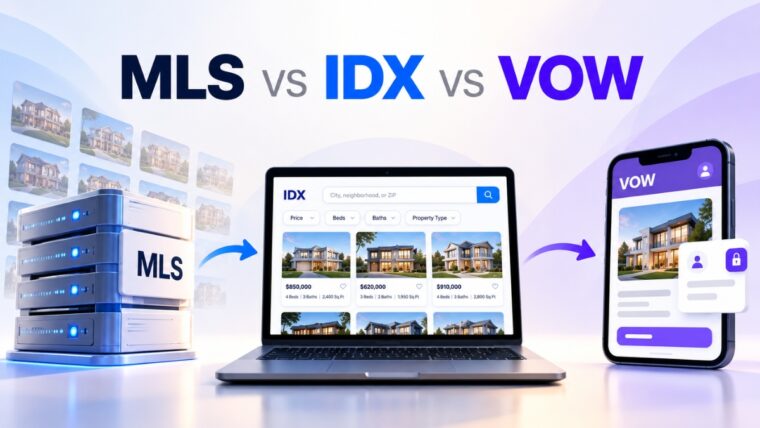
IDX cost in 2026 runs roughly $70 to $250 a month all-in, plus $100 to $350 in one-off fees to get started. That total is split between two organisations who bill you separately: your MLS, which licenses the data, and your IDX vendor, which displays it. Almost nobody quotes both.
This page puts every line item in one place, with the published 2026 figures, so you can work out your own number before anyone gets you on a call.
In this guide
- Who are you actually paying?
- What do IDX vendors charge in 2026?
- What does your MLS charge?
- What is the total IDX cost all-in?
- Why is IDX pricing so hard to find?
- Which costs can you actually avoid?

Who are you actually paying?
Three separate parties, and confusing them is why quotes never match reality.
- Your MLS owns the listing data and licenses it to you under an IDX agreement. It may charge a monthly data fee and a one-time approval fee.
- Your IDX vendor receives that feed and turns it into a search on your site. This is the monthly subscription people think of as “the IDX cost”.
- Your website is where it all lands. Separate cost, covered in the website cost breakdown.
Crucially, the MLS fee follows you, not the vendor. Changing IDX providers does not remove it, which is why “IDX included” offers are always including only part of the bill.
What do IDX vendors charge in 2026?
Published pricing for the most widely used providers. Note how differently the setup fees behave.
| Vendor | Entry plan | Higher tiers | Setup fee |
|---|---|---|---|
| IDX Broker | Core, $60/mo | Engage $99, Elite $149 | $100 account setup |
| Showcase IDX | Essentials, $94.95/mo | Premium $124.95 | $0 |
| iHomefinder | Lead Essentials, $169/mo | Lead Maximizer $399, Growth Pro custom | $500 if adding hosted site |
Figures from each vendor’s 2026 published price sheets, as summarised in IDX Broker pricing breakdowns and iHomefinder’s plan comparison. IDX Broker’s $100 setup is waived for accounts created under a developer partner — worth asking your developer about, because it is free money.
What does your MLS charge?
This is the part that varies most and gets quoted least, because it depends entirely on your board.
| Charge | Typical range | Notes |
|---|---|---|
| Monthly IDX data fee | $10–$70/mo | Some MLSs include it in dues and charge nothing |
| Vendor pass-through fee | $5–$30/mo | Billed by your IDX vendor, on the MLS’s behalf |
| One-time IDX approval | $100–$250 | Covers staff review of your site and paperwork |
| Application or connection fee | $50–$300 | Where charged separately from approval |
Ranges are drawn from MLS access cost surveys and Showcase IDX’s own documentation of MLS pass-through fees. Many US boards include basic IDX access in membership dues, so the honest answer for some agents is zero — and you will not know which you are until you ask.
Ask your MLS three questions: is IDX included in my dues, what is the monthly data fee, and is there a one-time approval charge. Five minutes on the phone replaces all guesswork.
What is the total IDX cost all-in?
Three realistic scenarios, combining vendor and MLS costs. Year one includes one-off fees; year two onward is the recurring figure.
| Scenario | Monthly | One-off | Year one | Year two |
|---|---|---|---|---|
| Lean: IDX Broker Core, MLS includes IDX in dues | $60 | $100 | $820 | $720 |
| Typical: Showcase IDX Essentials, $25 MLS fee | ~$120 | $150 | $1,590 | $1,440 |
| Heavier: iHomefinder Lead Essentials, $50 MLS fee | ~$219 | $250 | $2,878 | $2,628 |
Set that against a one-time website build and the proportions become clear: for many agents, IDX costs more every year than the website cost once. That is the single most useful thing to understand before choosing either.
Why is IDX pricing so hard to find?
Three structural reasons, none of them a conspiracy.
- The MLS portion genuinely varies. There are hundreds of MLSs in the US, each setting its own fees. No vendor can publish a single accurate total.
- Bundling hides the split. Platforms that include IDX in a monthly fee are still paying the MLS. You just cannot see how much.
- Quote-on-a-call converts better. An unpublished price is a conversation, and conversations sell.
Which costs can you actually avoid?
Four are negotiable or avoidable. The rest are not.
- Vendor setup fees. Often waived through a developer partner account, or during promotions. Always ask.
- Paying for tiers you do not use. Entry plans display listings perfectly well. Higher tiers mostly add CRM features you may already have.
- Second MLS feeds. Covering two boards doubles the data fee. Worth it only if you genuinely transact in both.
- IDX in year one. If nobody is finding your site yet, a property search is a cost without an audience.
What you cannot avoid is the MLS data fee where your board charges one. That is the price of the listings, and it applies whoever builds your website.
How IDX cost changes with the size of your board
Board size is the variable nobody mentions on a sales call. Larger MLSs generally have more mature data infrastructure and lower per-agent charges; small regional boards often charge more for less, and some still levy a separate technology fee.
| Board type | Typical MLS side | Notes on IDX cost |
|---|---|---|
| Large metropolitan MLS | $0–$50 setup, often no monthly | Lowest total IDX cost; modern Web API |
| Mid-sized regional | $50–$150 setup | Occasional annual data fee |
| Small or rural board | $100–$300 setup | Highest IDX cost per agent, slowest approval |
| Statewide aggregator | Varies | May cover several boards in one feed |
Before comparing vendors, ring your board and ask three questions: is there a setup fee, is there a recurring data fee, and do you run the RESO Web API. Those answers fix roughly half of your total IDX cost before any vendor is involved, and the approval process itself is set out in how to get IDX on your website.
What if you belong to two MLS boards?
Then you generally pay twice, and this is the single most common surprise in the whole subject. Most vendors price per feed, so a second board roughly doubles the vendor portion of your IDX cost rather than adding a small increment.
| Boards | Vendor, typical | MLS side | Annual IDX cost |
|---|---|---|---|
| One | $40–$80 a month | $0–$150 once | ~$480–$1,110 |
| Two | $80–$150 a month | $0–$300 once | ~$960–$2,100 |
| Three | $120–$220 a month | Varies | ~$1,440–$2,940 |
Before accepting a doubled IDX cost, ask whether a statewide or aggregated feed covers both boards in one subscription. In several states it does, and nobody volunteers that information.
Also ask, honestly, whether you need the second feed at all. If 90% of your business is in one board’s territory, the second feed is a large IDX cost buying listings almost nobody on your site searches for.
Six ways to reduce your IDX cost
In order of how much they save and how little they cost you. The first three are free.
- Ask whether you need IDX yet. In year one, usually not. Removing it entirely takes the IDX cost to zero and loses you almost nothing while your pages are still being indexed.
- Drop to one board. If your second board produces no business, it produces no return on its feed either.
- Pay annually. Most vendors discount 10–20% for a yearly term.
- Downgrade the tier. Map search, saved searches and market reports sit on higher plans. If nobody uses them they are pure IDX cost.
- Check the vendor is not billing for a dead feed. Agents routinely pay for RETS feeds that stopped syncing months ago.
- Compare two vendors on your specific board, not on their published rate cards.
Steps one and two account for most of the savings available. Everything below them trims a real but modest amount off an IDX cost you have already decided to carry.
IDX cost over three years
Monthly figures disguise the total. Here is the same subscription over a realistic ownership period, which is the number worth putting next to what the feed actually earns you.
| Monthly | Year 1 | 3 years | Deals needed at $5,000 net |
|---|---|---|---|
| $30 | $360 | $1,080 | 0.22 |
| $50 | $600 | $1,800 | 0.36 |
| $80 | $960 | $2,880 | 0.58 |
| $150 (two boards) | $1,800 | $5,400 | 1.08 |
At the top row the IDX cost is trivially justified by a single transaction every few years. At the bottom it needs to produce roughly one deal per year on its own, which for most solo agents it does not.
Is the IDX cost worth it at all?
Genuinely, sometimes not, and very few people in this industry will say so. Here is the honest split.
- Worth it if buyers already land on your site from search, if you run a defined geographic farm, or if you advertise and need somewhere for traffic to convert.
- Not worth it yet if your site gets under a hundred visits a month, if you are in your first year, or if your listing pages are loaded in an iframe and therefore invisible to Google.
That last case is the worst use of money in the whole category: paying a recurring IDX cost for listing pages that search engines cannot see and visitors never reach. Check before you renew.
What is the vendor fee actually paying for?
It helps to know what the recurring charge buys, because it is not simply access to data — your membership already gives you that. The vendor is selling the machinery that turns a raw feed into pages a visitor can use.
- Maintaining the connection. Boards change fields, endpoints and credentials without much warning. Somebody has to keep up, and that is most of what you are paying for.
- Normalising the data. Every board names and formats fields differently. Turning that into consistent listing pages is genuine engineering.
- Compliance. Required disclaimers, attribution, refresh frequency and exclusion rules all vary by board and are audited.
- Search, filtering and mapping. The part visitors actually interact with.
- Hosting the query load. Listing search is far heavier than serving ordinary pages.
Seen that way the recurring charge is more defensible than it first appears. It is maintenance of a moving connection rather than rent on static data, which is also why the cheapest option is not automatically the best value.
Questions that expose the real figure on a sales call
Vendors quote on calls precisely because the number moves. Ask these seven and write the answers down; the total IDX cost you end up with usually depends more on what you asked than on which vendor you chose.
- What is the all-in monthly figure for my specific board? Not the starting price on the website.
- Is there a setup or onboarding fee, and is it refundable if the board rejects the application?
- Does my MLS charge you, and do you pass that through?
- What does a second board add? Get the exact figure rather than “a small amount”.
- Are listing pages server-rendered or in an iframe? If they are framed they will not be indexed, and the entire IDX cost buys you nothing in search.
- What happens if the board switches standards? Is re-establishing the feed included or chargeable?
- Is there a minimum term, and does it auto-renew?
Question five matters more than the price. A cheap framed feed and an expensive indexable one are not the same product, and comparing them on monthly cost alone is how agents end up paying for years to display listings Google has never seen.
Finally, ask for two live client sites on your own board and open them on a phone. Search one of the listing addresses in Google. If the page comes up, the vendor is selling what you think you are buying.
Budgeting for it alongside everything else
The feed does not exist in isolation. For a solo agent it usually sits third in the stack behind hosting and the site itself, and it is by some distance the largest recurring line of the three.
- Domain: $10–$20 a year. Non-negotiable and trivial.
- Hosting: $96–$360 a year. Also unavoidable.
- The site: one-time, or $700–$3,600 a year rented.
- The feed: $360–$2,100 a year depending on boards and tier.
On an owned site the IDX cost is frequently the single biggest thing you pay for every month, which is worth sitting with for a moment. It means the listings feed deserves the same annual review you would give a portal lead package, rather than being treated as a fixed cost of doing business.
Once a year, open your analytics and look at how many visits your listing search actually received. If the answer is a handful, you have found the easiest saving available to you, and the IDX cost can wait until the rest of the site is pulling traffic worth converting.
Frequently asked questions
Is IDX included in my MLS dues?
Sometimes. Many US boards include basic IDX access in membership, so the only cost is your vendor’s subscription. Others charge a monthly data fee on top, commonly $10 to $70, and some add a one-time approval charge. Only your MLS can tell you which applies.
Why did my IDX plugin stop working?
Most commonly because the feed standard changed. MLSs have moved from the older RETS protocol to the RESO Web API, and vendors have retired RETS support — Realtyna ended all RETS integrations at the end of 2024. A plugin built for RETS against an MLS that has switched will simply stop receiving data.
Can I use one IDX subscription across two websites?
Usually not. IDX agreements are tied to a specific approved site, and displaying the feed elsewhere generally breaches both the vendor’s terms and your MLS agreement. Some vendors sell multi-site plans; ask before assuming, because compliance breaches can cost feed access.
Is a cheaper IDX vendor worse?
Not for displaying listings. The meaningful differences at higher tiers are lead capture, CRM and automation, not the search itself. What matters far more than price is whether the vendor supports your specific MLS — check that before anything else.
Does the IDX cost include my MLS dues?
No. MLS membership dues, association dues and the IDX cost are three separate bills. Dues buy you access to the data as a member; the IDX feed and the vendor that displays it are charged on top.
Why will vendors not publish a full IDX cost?
Because the MLS portion genuinely varies by board, and because quoting on a call allows price discrimination. Ask for the all-in figure for your specific board, in writing, before you commit.
Can I pause an IDX subscription off-season?
Rarely, and it is usually a false economy. Re-establishing a feed can mean a fresh compliance review and another wait of days to two weeks, so the saved IDX cost buys you an outage at the start of the season.
The bottom line
Budget an IDX cost of $70 to $250 a month, plus $100 to $350 to get started, and treat any quote that does not separate the MLS fee from the vendor fee as incomplete. Call your MLS first; the answer to “is IDX included in my dues” can move your annual cost by several hundred dollars.
And remember the sequencing: IDX is a recurring cost that only pays off once people are actually finding your site.

Asraful Islam
Real estate website developer and founder of Reaplex. 200+ real estate websites built, rated 5.0 from 180+ reviews on Fiverr and Upwork.
More about me