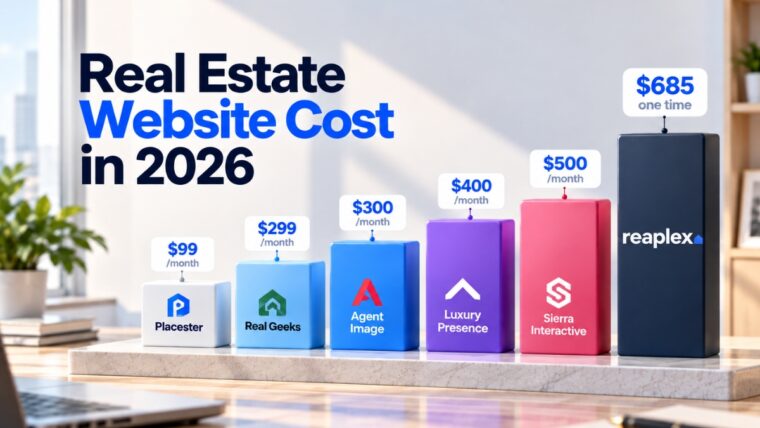
Real estate website monthly fees buy convenience, but when you stop paying you usually lose more than the website. The IDX feed configuration, saved client searches, drip campaigns and years of CRM history commonly go with it — and on some contracts, control of the domain too.
None of that is hidden. It is simply in the terms nobody reads at signup, when leaving feels hypothetical. This is what to check before you sign, and how to work out what the arrangement really costs.
In this guide
- What happens when you stop paying?
- What exactly do you lose?
- Who actually owns your domain?
- What do real estate website monthly fees really cost?
- What should you ask before signing?
- When is a monthly platform worth the trade?
What happens when you stop paying real estate website monthly fees?
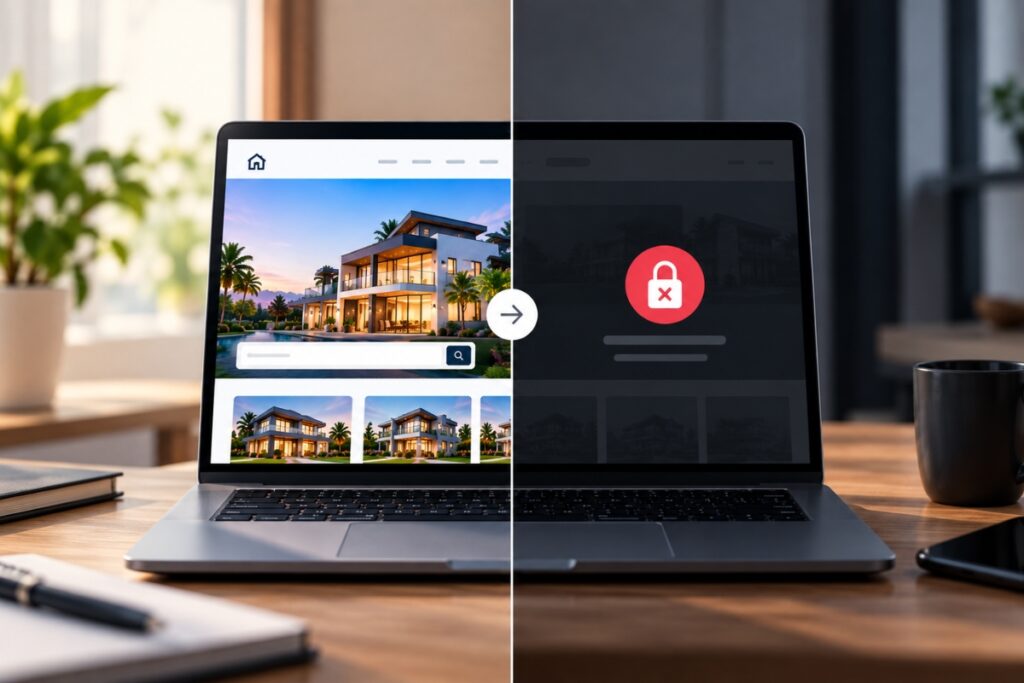
The site goes dark, usually within days of the billing failure. What happens to everything attached to it varies by platform, and that variation is the whole risk. Cancelling a bundled subscription can take the IDX configuration, saved searches, drip campaigns and CRM history with it — and in some cases the domain, depending on whose account it was registered in.
Not every platform behaves the same way. Some keep your pages and posts stored as a draft in your account, so the content survives even when the site is offline. The only way to know which kind you are on is to read the agreement or ask in writing.
What exactly do you lose?
Six assets are typically bundled, and they do not all carry the same risk. Ranked by how painful losing each one is:
| Asset | Typically survives cancellation? | How bad is losing it |
|---|---|---|
| Domain name | Only if registered in your own account | Severe — you lose your address and any equity in it |
| CRM history and past-client records | Sometimes, by export only | Severe — this is your actual business |
| Published content and pages | Rarely in a usable form | High — months of writing, and the rankings with it |
| IDX feed configuration | No — it is tied to the platform | Moderate — rebuildable, but slow |
| Saved searches and lead activity | Rarely | Moderate — buyer intent data you cannot recreate |
| Design and layout | No | Low — it was a template anyway |
The two at the top are the ones to care about. Design is replaceable in a fortnight. A decade of client records is not.
Who actually owns your domain?
This is the single question worth asking before anything else, because it is the difference between changing suppliers and starting again.
If your domain sits in an account you control at a registrar, cancelling costs you hosting and support and nothing else — you point the domain somewhere new and carry on. If the provider registered it under their own account as part of “setting everything up for you”, then your address, your email and every link anyone has ever shared belong to a company you are in the middle of leaving. Reputable providers register client domains in the client’s own account precisely to avoid that dispute.
Check it today, in five minutes: run a public WHOIS lookup on your domain and see whose organisation and email appear as the registrant. If it is not you, fix it while the relationship is still friendly.
What do real estate website monthly fees really cost?
Bundling is what makes the monthly fee feel reasonable: website, IDX, CRM, lead routing and drip campaigns in one line item. The catch is that the bundle prices as one thing and leaves as one thing.
Priced over five years, bundled platforms typically cost several times what a custom website plus an independent CRM plus an independent IDX integration would — and the unbundled version leaves each piece in your hands. The trade you are making is convenience now against portability later.
| Bundled platform | Unbundled, owned | |
|---|---|---|
| Monthly cost | $99–$500 | Hosting ~$150/yr, plus IDX |
| If you stop paying | Site offline, data at risk | Site stays up |
| Switching CRM later | Usually means leaving the website too | Swap the CRM, keep the site |
| Who holds the content | The platform | You |
| Setup effort | Low — one vendor | Higher — a few moving parts |
What should you ask before signing?
Six questions, and ask for the answers by email rather than on a call. A vendor comfortable with their terms will answer all six in a paragraph.
- Whose registrar account is my domain in, and can I see it?
- If I cancel, what exactly happens to the site — offline, deleted, or held as a draft?
- Can I export my CRM contacts and history, in what format, and at any time?
- Can I export my published pages and blog posts as content I can reuse?
- Is there a minimum term, and what is the notice period?
- Who holds the IDX agreement with my MLS — me, or you?
Question six catches people out. If the IDX agreement is in the provider’s name, your listing feed is their relationship with your MLS, and re-approval can take anywhere from days to a fortnight when you move.
When are real estate website monthly fees worth the trade?
When you use the whole bundle. If the CRM is genuinely where your day happens — pipelines, follow-up, routing to your team — then you are buying software with a website attached, and paying monthly for software is normal. The lock-in is a fair price for a system doing real work.
It stops being worth it when you use maybe a fifth of what you pay for. That is the common case: an agent on a $300 plan using it as a brochure and a contact form, because the CRM was never set up properly and the drip campaigns were never written.
Audit it honestly. Log in and look at what you have actually used in the past ninety days. If the answer is “the website and nothing else”, you are paying software prices for a brochure, and the exit terms suddenly matter a great deal.
What do real estate website monthly fees actually cover?
Most of the bill is commodity infrastructure with a known market price, wrapped in software and support. Breaking real estate website monthly fees into parts is the fastest way to see what you are really renting.
| Part of the fee | Bought separately | Genuinely worth renting? |
|---|---|---|
| Hosting | $8–$30 per month | Marginal |
| Security, backups, updates | $0–$20 per month | Yes, if you would not do it |
| IDX feed | $30–$100 per month | Unavoidable either way |
| Template and page tools | — | Only if you use them |
| Support desk | — | Yes, if you call it |
| Design changes | — | Yes, if you request them |
Add the first two rows and you get roughly $50 a month of infrastructure. On a $250 plan, the remaining $200 buys tools and service. That is a fair trade if you use them weekly and a poor one if you do not, which is the entire argument about real estate website monthly fees in one sentence.
Which real estate website monthly fees are unavoidable?
Two, and only two. Everything else is a choice, and knowing which is which stops you comparing a platform quote against an imaginary free alternative.
- Hosting. The site has to be served from somewhere. $8–$30 a month on managed WordPress, or included in a platform plan.
- IDX, if you want live listings. MLS and vendor charges follow you between platforms, so they belong in every comparison of real estate website monthly fees rather than being treated as a platform feature.
Your domain is annual rather than monthly, and trivial at $10–$20 a year. Everything beyond those three lines — the template, the builder, the support desk, the landing pages — is optional, and it is where the difference between $40 and $400 a month lives.
How to cut real estate website monthly fees without losing anything
Before cancelling anything, work out what the site earned you last year. If the answer is real, leave it alone. If it is nothing, these five moves reduce real estate website monthly fees without touching anything that produces enquiries.
- Drop IDX for a year. If your listing pages get no traffic, you are paying $360–$1,200 a year to show listings nobody finds on your site.
- Downgrade the tier. Most agents sit on a plan bought for features they have never opened. Ask what the tier below actually removes.
- Pay annually. Many providers discount 10–20% for an annual term, which is the easiest reduction in real estate website monthly fees available.
- Cancel the add-ons. Newsletter tools, chat widgets and valuation gadgets are usually separately billed and rarely used.
- Move to a one-time build if you make changes once a year. This converts real estate website monthly fees into hosting and IDX only.
Do the first four before considering the fifth. Switching platforms costs money and attention, and it is not worth doing to save $40 a month you could have saved by downgrading.
Real estate website monthly fees over five years
One year flatters a subscription. Five years is the honest window, because that is roughly how long a website design lasts before it needs refreshing anyway.
| Monthly figure | Year 1 | 5 years | Owned at the end |
|---|---|---|---|
| $59 | $708 | $3,540 | Domain and content |
| $129 | $1,548 | $7,740 | Domain and content |
| $250 | $3,000 | $15,000 | Domain and content |
| $500 | $6,000 | $30,000 | Domain and content |
| One-time build + hosting | ~$985 | ~$2,185 | The site as well |
By year five, a mid-tier subscription has cost more than a fully custom build. That is not an argument that real estate website monthly fees are wrong — plenty of agents get their money back several times over — but it is an argument for checking, annually, whether yours still does.
Set these figures against NAR’s number for median income in an agent’s first two years, about $8,100. At $250 a month, real estate website monthly fees consume 37% of that. At $59 they take under 9%.
What to ask before you accept real estate website monthly fees
Six questions, answered in writing before you sign. Any provider worth paying will answer all six without hesitating.
- Who is the registrant on the domain? The only acceptable answer is you.
- What exactly do I receive at cancellation? Content export, lead export, full URL list.
- Are IDX charges inside or outside these real estate website monthly fees, and are they per MLS board?
- Does the plan auto-renew, and what notice is required to stop it?
- What counts as an included change? Text edits, new pages and design changes are usually treated differently.
- Can I see three live client sites? Run each through PageSpeed Insights before the call ends.
The first two matter most. Real estate website monthly fees are survivable at almost any level if you own the domain and can take your content with you; they become a trap only when leaving means starting from nothing.
What happens to your fees when you change brokerage?
This catches people out, and it is worth settling before you sign rather than during a move. Agents change brokerage far more often than they change websites, and the two interact in ways nobody mentions at the sales stage.
- A brokerage-provided site ends with the brokerage. The page, the URL and every bit of search visibility attached to it stay behind. You pay no real estate website monthly fees, and you also keep nothing.
- Your IDX approval is tied to your membership and your broker. Moving usually means re-applying, with the same days-to-two-weeks wait as a new agent.
- Compliance rules change. Most boards require your broker’s name and licence details displayed; a new brokerage means updating every page that carries them.
- Your own site survives untouched. If the domain is in your name, a brokerage move costs you an afternoon of edits rather than your entire online presence.
That last point is the strongest practical argument for paying real estate website monthly fees on a site you control, or buying one outright, rather than accepting a free brokerage page. The free option is genuinely free right up until the day you leave, at which point it costs you everything you built on it.
Before you accept any arrangement, ask one question: if I moved brokerage next month, what would I still have? If the honest answer is your domain and your writing, the real estate website monthly fees are buying you something durable. If the answer is nothing, they are not fees at all — they are rent on someone else’s asset.
Frequently asked questions
Can I take my content with me when I leave a platform?
Sometimes, and rarely in a convenient form. Many platforms allow a CSV export of contacts but no clean export of pages, so the text has to be copied manually. Ask for a sample export before you sign. If nobody can show you one, assume the content stays behind.
Will I lose my Google rankings if I switch platforms?
Only if the migration is careless. Rankings attach to URLs, so keeping the same domain and redirecting every old address to its match preserves most of the value. Problems come from changing the domain, dropping pages, or letting the old site vanish before redirects exist.
My provider registered my domain. How do I get it back?
Ask them to transfer it to a registrar account in your name and to release the authorisation code. Most will do this on request. Do it while you are still a paying customer and on good terms — a domain transfer requested mid-cancellation is a slower and less friendly conversation.
Is a one-time build really cheaper if I still pay for hosting and IDX?
Usually, because those two costs exist either way. IDX is licensed from your MLS whoever builds the site, and hosting runs roughly $100 to $300 a year. What disappears is the platform fee sitting on top — which is the part that compounds. The five-year comparison is here.
Are real estate website monthly fees tax deductible?
In the US they are normally an ordinary business expense, as is a one-time build, though a larger build may be treated differently. This is genuinely a question for your accountant rather than your web developer, and the answer rarely changes which option is cheaper overall.
Do real estate website monthly fees usually rise?
Yes, gradually. Platforms adjust pricing and add tiers, and existing customers are moved across at renewal. Ask whether your rate is locked and for how long, and diarise the renewal date so it is never a surprise.
Is a cheaper plan worse for SEO?
Not in itself. What matters is mobile speed, whether listing pages are indexable, and whether anyone writes local content. Higher real estate website monthly fees buy design and service, neither of which Google can see.
The bottom line
Real estate website monthly fees are not a trap simply because they are monthly. It becomes one when the thing you are renting quietly holds assets that should be yours — your domain, your client records, your published work.
Check the domain today. Get the export answers in writing. Then decide with your eyes open, because the moment you need those answers is the worst moment to go looking for them.

Asraful Islam
Real estate website developer and founder of Reaplex. 200+ real estate websites built, rated 5.0 from 180+ reviews on Fiverr and Upwork.
More about me